The car ownership transfer (balik nama) cost in 2026 for a used vehicle generally ranges from IDR 575,000 to IDR 675,000, excluding annual tax. This is far lower than a few years ago because the Motor Vehicle Title Transfer Fee (BBNKB) for used cars has not been charged since January 5, 2025. What you still pay are the fees for issuing a new STNK (vehicle registration certificate), BPKB (vehicle ownership book), and license plate, plus Motor Vehicle Tax (PKB) if it is due.
For General Affairs or procurement teams, ownership transfers usually come together with other decisions. Examples include buying a used unit for a new branch, receiving assets from a subsidiary, or moving an operational vehicle to another city. The cost may not be large, but a single missing document can leave a vehicle stuck without papers in the company's name. That is why it helps to first understand what you pay, which documents to prepare, and how the process works, including for vehicles registered to a business entity.
A vehicle ownership transfer is the process of changing the owner's details on the STNK and BPKB after a vehicle changes hands, whether through a sale, gift, inheritance, or auction. It is handled at Samsat, an integrated service involving the Police, the Regional Revenue Agency, and Jasa Raharja. The obligation still applies even though the transfer fee for used vehicles has been abolished.
The removal of BBNKB is often misread as the end of the obligation to transfer ownership. In fact, the obligation is still regulated under National Police Chief Regulation No. 5 of 2012 on Motor Vehicle Registration and Identification. The Director General of Regional Finance Development at the Ministry of Home Affairs, Agus Fatoni, has also urged owners of used vehicles to transfer ownership promptly so that vehicle data matches the actual owner.
Postponing the transfer also has real consequences. According to the police, electronic traffic ticket (ETLE) confirmation letters are sent to the address listed on the STNK. If the letter is not responded to, the STNK can be blocked. For companies, vehicles that have not been transferred also create a mismatch between asset records in the books and their legal documents, which often becomes an audit finding.
For used cars, the ownership transfer cost in 2026 consists of STNK issuance at IDR 200,000, BPKB at IDR 375,000, and a license plate at IDR 100,000 if replaced. The total is IDR 575,000 to IDR 675,000. The BBNKB is IDR 0. Beyond that, PKB, the PKB surcharge (opsen), and SWDKLLJ are paid according to the bill, and there is a registration transfer letter fee if the vehicle moves to another region.
All of the administrative fees above are Non-Tax State Revenue (PNBP), meaning official charges deposited into the state treasury. The amounts are set in Government Regulation No. 76 of 2020 on the types and rates of PNBP applicable at the Police. The table below summarizes the rates for cars and motorcycles.
The SWDKLLJ (Mandatory Road Traffic Accident Fund Contribution) rates collected by Jasa Raharja above apply to private cars and motorcycles of 50-250 cc. Other vehicle classes have different rates, so the exact amount still follows the bill at Samsat.
Suppose a company in Semarang buys a used MPV from an owner who is also registered in Semarang. The STNK is still valid for three years, the annual tax is not yet due, and the license plate is not replaced. The company only needs to prepare IDR 575,000, which is the STNK at IDR 200,000 plus the BPKB at IDR 375,000.
The calculation changes if the annual tax falls due at the same time, because PKB, the PKB surcharge, and SWDKLLJ will also be billed. Something often overlooked is tax arrears left by the previous owner. These arrears and their penalties must be paid before the transfer is processed. Check the vehicle's tax status before the transaction, then use any arrears as a point in price negotiations.
BBNKB is now only charged when a vehicle is bought new, also known as the first transfer. Used cars, meaning the second transfer onward, are no longer subject to this tax anywhere in Indonesia. For new cars, the maximum BBNKB rate is 12 percent of the selling value, plus a 66 percent surcharge collected by the regency or city government.
This rule comes from Law No. 1 of 2022 on Financial Relations between the Central and Regional Governments (HKPD Law). Article 12 paragraph (1) of the HKPD Law limits the BBNKB object to the first transfer. This provision took effect three years after the law was enacted, on January 5, 2025. Previously, transfers of used vehicles were subject to a 1 percent BBNKB.
For new cars, the amount is quite significant. As an illustration, a new car in East Java with a selling value of IDR 300 million and a 12 percent BBNKB rate has a base BBNKB of IDR 36 million. With the surcharge added, the total becomes IDR 59.76 million. This cost is usually already included in the on-the-road (OTR) price, meaning the price of a vehicle ready to drive, so new car buyers rarely handle it themselves.
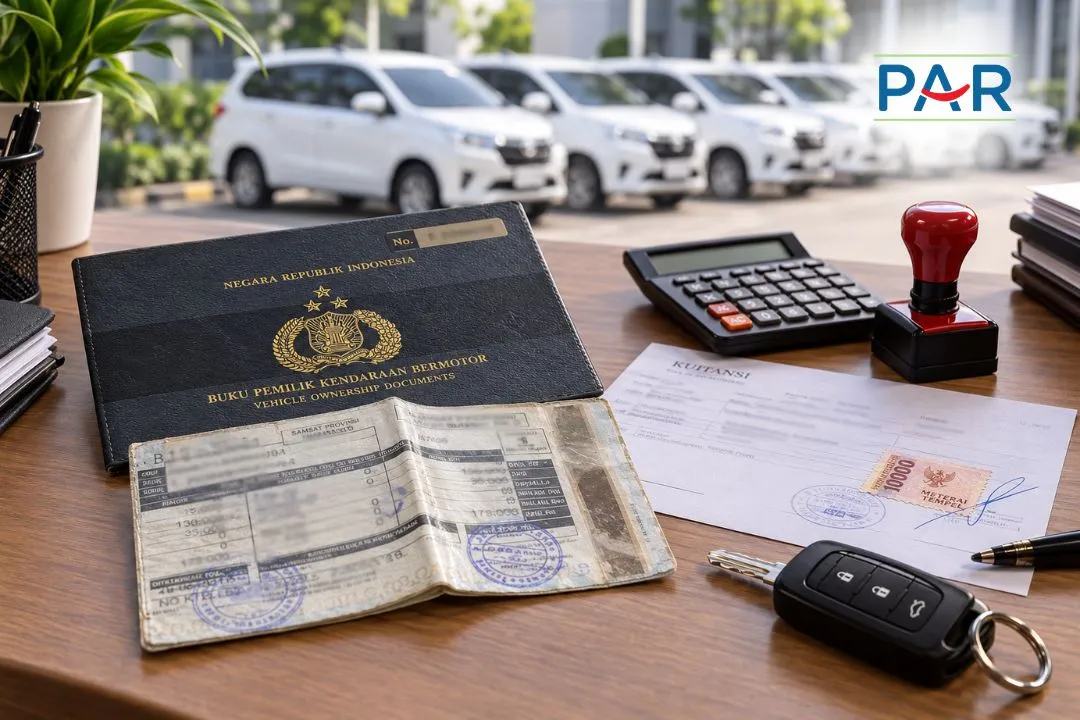
The requirements for transferring ownership of a used vehicle include the original BPKB and STNK, proof of transfer of rights such as a sales receipt with a duty stamp, the new owner's identity, and the results of a physical vehicle check. The previous owner's ID card is now generally no longer required. If the new owner is a company or institution, additional documents are needed, as covered in the section on company vehicles.
The original BPKB and a photocopy
The original STNK and a photocopy
A sales receipt with a duty stamp, or a deed of gift, inheritance letter, or auction minutes depending on the type of transfer
A release of rights letter, only if the vehicle was previously registered to a company
Samsat currently no longer generally requires the previous owner's ID card. Even so, keep a copy of the seller's ID as an internal record. The copy is useful if any data needs to be clarified.
The new owner's e-KTP (electronic ID card)
A power of attorney with a duty stamp, if someone else handles the process
Physical vehicle check results from Samsat
Requirements may vary slightly between regions. Before going, check the official Samsat or Bapenda (Regional Revenue Agency) website for the province where the vehicle will be registered.
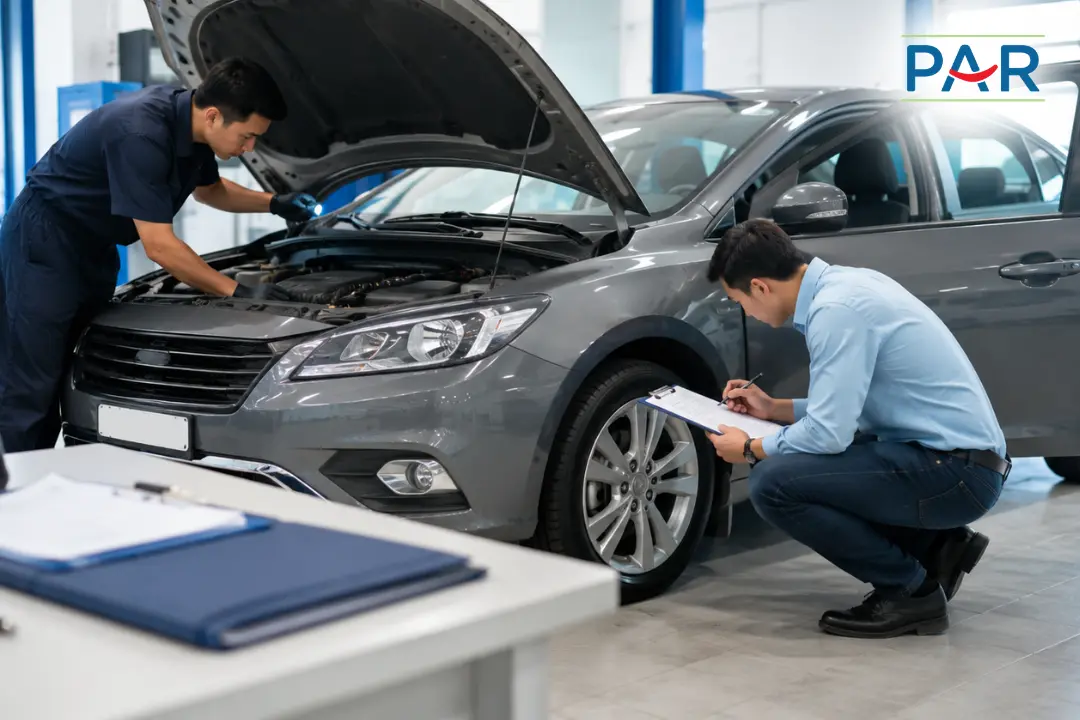
The car ownership transfer takes place in two stages. First, the STNK is replaced at Samsat after the vehicle undergoes a physical check. Second, the BPKB is replaced at the BPKB unit of the Regional Police (Polda) or Resort Police (Polres). The process cannot yet be done fully online, because officers must directly inspect the vehicle's chassis and engine numbers.
Complete the seller's and buyer's documents, including photocopies.
Bring the vehicle to Samsat for a physical check of the chassis and engine numbers.
Submit the physical check results and documents at the STNK ownership transfer counter.
Pay the PNBP and any taxes billed at the cashier counter.
Collect the new STNK and license plate on the date set by the officer.
Proceed to the BPKB unit with the original BPKB, a photocopy of the new STNK, the physical check results, and proof of transfer of rights.
Collect the new BPKB according to the schedule on the receipt.
The length of the ownership transfer process varies by region, depending on document completeness and queues at the Samsat office. For transfers within the same city, the new STNK can generally be collected within a few working days on the date set by the officer. The BPKB is processed separately at the Polda or Polres, so it usually takes longer and is collected on the date stated on the receipt. Transfers to another region take extra time because they go through two Samsat offices.
The process is likely to become faster going forward. The Indonesian National Police Traffic Corps (Korlantas Polri) is targeting the electronic BPKB (e-BPKB) to apply nationwide from January 1, 2027, so registration will no longer depend on manual paperwork. Camera-based digital physical checks are also starting to replace the manual rubbing method in several regions.
Transferring ownership of a company vehicle requires corporate legal documents: a copy of the deed of establishment, a certificate of domicile, the company's Taxpayer Identification Number (NPWP), and a power of attorney with a duty stamp signed by management and bearing the company stamp. For government agencies, state-owned enterprises (BUMN), and regional-owned enterprises (BUMD), the main document is an assignment letter or power of attorney from management. If buying a used vehicle owned by another company, a release of rights letter must be included.
These requirements follow the provisions applied by Samsat offices in various regions, including the obligation for legal entities and government agencies to attach an NPWP and physical check results. In practice, the most common obstacle is the power of attorney. The signatory must be an official whose name appears in the latest deed or decree, and the proxy's name must match the identity of the staff member who visits Samsat. If the board of directors has changed, also include a copy of the latest amendment deed.
Besides ownership transfers, certain operational vehicles such as goods vehicles, buses, and public transport vehicles must also undergo periodic vehicle roadworthiness tests (KIR). Both tasks should be part of a single fleet administration calendar so that no document is missed.
Ex-fleet company vehicles are in high demand because their maintenance history is usually well documented. When buying a unit like this, make sure the seller issues a release of rights letter. Without it, the transfer application will almost certainly be returned. Also ask for the service history and proof of the latest tax payment so that no arrears are carried over.
Imagine a head office in Jakarta buying five ex-fleet units from its Medan branch for use in Jakarta. Each unit must go through a transfer-out in North Sumatra, then be re-registered in Jakarta with a new plate. The process involves physical checks, document verification in two cities, and one GA staff member who has to travel back and forth handling the paperwork. The official cost may only be a few million rupiah, but the internal working hours consumed are far greater.
Situations like this lead many companies to reconsider owning vehicles versus long-term rental. Under a rental scheme, vehicles are registered to the service provider, so the renting company does not need to handle ownership or registration transfers every time a unit is needed in another city. Routine maintenance and after-sales service are also generally included, so the internal team can focus more on calculating company vehicle operating costs and routine operational car servicing schedules.
A same-city transfer only needs to be processed at the Samsat where the vehicle is registered, and the license plate generally stays the same. An out-of-town transfer must go through a registration transfer (mutasi), which means withdrawing the file from the original Samsat with a transfer-out letter fee of IDR 250,000 for cars, then registering the vehicle at the destination Samsat. There, the vehicle receives a new STNK, plate, and BPKB.
The Banten Provincial Bapenda explains that the transfer-out file from the original Samsat is the main requirement for processing the transfer-in at the destination Samsat. Transfers between regencies within the same province can be simpler than transfers between provinces. That is why you should confirm with the original Samsat before withdrawing the file.
Is transferring ownership of a used car now free?
Not entirely. Only the BBNKB for used vehicles has been abolished since January 5, 2025, under Law No. 1 of 2022. New owners still pay the PNBP for the STNK, BPKB, and license plate, as well as PKB and SWDKLLJ if they are due.
How much does a motorcycle ownership transfer cost in 2026?
The motorcycle ownership transfer cost in 2026 consists of STNK issuance at IDR 100,000, BPKB at IDR 225,000, and a license plate at IDR 60,000 if replaced, under Government Regulation No. 76 of 2020. The total is IDR 325,000 to IDR 385,000, excluding annual tax. The BBNKB for used motorcycles is also IDR 0.
Can ownership be transferred without the previous owner's ID card?
Yes. The ownership transfer process for used vehicles now generally no longer requires the previous owner's ID card. Buyers only need to bring the original BPKB and STNK, a sales receipt with a duty stamp, their e-KTP, and the physical check results.
Can a vehicle ownership transfer be done online?
Not fully. The vehicle still has to be brought to Samsat for a physical check of the chassis and engine numbers. Korlantas Polri aims to make the ownership transfer process increasingly digital as the e-BPKB is rolled out nationwide in 2027.
What are the risks of not transferring ownership of a used car?
The vehicle remains registered to the previous owner, so electronic traffic ticket confirmation letters are sent to someone else's address and the tax obligation stays in the previous owner's name. If the ETLE confirmation letter is not responded to, the STNK can be blocked. The new owner will also face difficulties when renewing the STNK every five years.
What if the BPKB is still held by the leasing company?
An ownership transfer requires the original BPKB, so the vehicle loan must first be settled with the financing company. Samsat officers generally advise owners to coordinate with the leasing company, or even hand the process over to them. Once the BPKB is received, the transfer at Samsat proceeds as usual.
Since BBNKB for used vehicles was abolished, the car ownership transfer cost in 2026 only covers the PNBP for the STNK, BPKB, and license plate, plus any taxes currently due. The biggest challenge lies in document completeness, especially for company-owned vehicles and units moving between cities. Preparing the power of attorney, deeds, and release of rights letter early will save a lot of time at Samsat.
For companies that want to be free from vehicle administration, Prima Armada Raya offers long-term vehicle rental for corporates through PRIMA Fleet Services. Options range from VIP vehicles, daily operational cars, and buses to electric vehicles, backed by 3,000+ fleet units across 30+ operating areas, real-time fleet monitoring, and 24/7 customer service. If your company prefers to buy its own units, quality used vehicles are available from PRIMA Autocare & Sales. Complete your setup with corporate driver outsourcing services to keep your team's mobility safe, comfortable, and reliable, #PilihYangPRIMA.