The annual STNK (vehicle registration certificate) renewal cost in 2026 consists of three components: Motor Vehicle Tax (PKB), the PKB surcharge (opsen) in provinces that apply it, and the Mandatory Road Traffic Accident Fund Contribution (SWDKLLJ). For private cars, the SWDKLLJ payable is IDR 143,000 per year, while the PKB amount depends on the vehicle's value and the provincial rate. Annual STNK endorsement is no longer charged, and fees for printing a new STNK and license plate only apply to the five-year renewal.
For someone who owns one car, annual renewal may be just a routine task. It is a different story for General Affairs teams handling dozens of operational vehicles with different due dates. A single missed unit can lead to fines, disrupt business trips, and trigger findings in an internal audit. This article covers the cost breakdown, requirements, renewal process, how to calculate fines under the latest rules, and the specific procedure for company-owned vehicles.
The annual STNK renewal cost is the sum of the base PKB, the PKB surcharge (in provinces that apply it), and the SWDKLLJ according to the vehicle class. All of these amounts are printed on the STNK or tax notice and can be checked through the regional Samsat (One-Stop Administration Service Office) app. Apart from these three components, there are no other official charges for annual renewal.
PKB is a provincial tax on the ownership or control of a motor vehicle. It is calculated from the Motor Vehicle Selling Value (NJKB) multiplied by the rate set in the regional regulation. For example, DKI Jakarta Regional Regulation No. 1 of 2024 sets a rate of 2% for an individual's first vehicle and 2% for vehicles owned by business entities. Progressive rates apply to individuals, starting at 3% for a second vehicle and rising to 6% for a fifth vehicle and beyond.
Since January 5, 2025, Law No. 1 of 2022 on Financial Relations between the Central and Regional Governments (HKPD Law) has introduced the PKB surcharge. The PKB surcharge is an additional levy of 66% of the base PKB, allocated to regency/city governments. DKI Jakarta does not apply the surcharge because it has no autonomous regencies or cities, so STNKs for B-plate vehicles registered in Jakarta list only the base PKB.
SWDKLLJ is a mandatory annual contribution managed by PT Jasa Raharja (Persero) to compensate traffic accident victims. Its rate is set by vehicle class and already includes a fund card fee of IDR 3,000.
Most official and operational company vehicles fall into class DP. Truck fleets and large-capacity goods vehicles fall into class F.
Much of the information online still lists an STNK endorsement fee of IDR 25,000 for motorcycles and IDR 50,000 for cars. That fee was annulled by the Supreme Court in 2018. The court's reasoning was that endorsement of documents by government officials may not be charged under Article 73 paragraph (5) of Law No. 30 of 2014 on Government Administration, and that the fee amounted to double charging. The Indonesian National Police Traffic Corps (Korlantas Polri) has also confirmed that physical vehicle checks at Samsat are free of charge.
The STNK issuance fee (IDR 200,000 for four-wheel vehicles) and the license plate or TNKB fee (IDR 100,000 for four-wheel vehicles) under Government Regulation No. 76 of 2020 are only paid every five years. Details of the five-year renewal are covered separately in our article on the five-year car plate replacement cost.
Suppose an operational MPV is registered in Jakarta with a base PKB of IDR 3,000,000. Its annual renewal cost is IDR 3,000,000 + IDR 143,000 = IDR 3,143,000. If the same vehicle is registered in a province that applies the surcharge, the STNK will list the base PKB and the PKB surcharge separately. To find out how much you need to pay, simply add up all the printed components.
The requirements for annual STNK renewal for individually owned vehicles are fairly simple: the original STNK and the original electronic ID card (e-KTP) of the owner whose name matches the STNK. Some provinces, such as West Java, no longer require the BPKB (vehicle ownership book) for annual renewal. Throughout 2026, Korlantas Polri has also relaxed the requirement for the previous owner's ID card for vehicles whose ownership has not yet been transferred.
Documents to prepare:
The original STNK and a photocopy (photocopies are not needed for online renewal).
The vehicle owner's original e-KTP and a photocopy.
A power of attorney with a duty stamp, along with the proxy's ID card, if someone else handles the renewal.
The original BPKB and a photocopy, only if your local Samsat still asks for it.
For used vehicles whose ownership has not been transferred, the Director of Registration and Identification at Korlantas Polri stated that annual renewal without the previous owner's ID card applies nationwide, but only during 2026. Owners only need to bring the original STNK and the new owner's ID card, then fill out an ownership transfer statement form. From 2027, all vehicles must be transferred to the current owner's name. Under the HKPD Law, the title transfer fee for used vehicles has been waived since 2025, so the only remaining cost is the non-tax state revenue (PNBP) for issuing new documents.
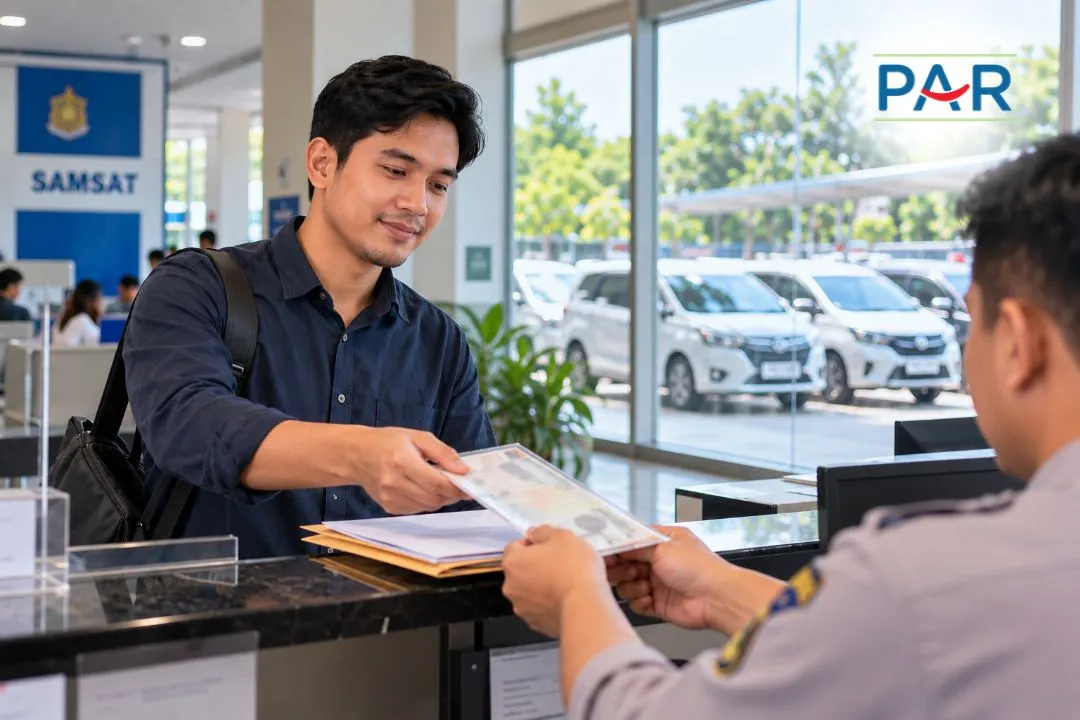
You can renew your STNK annually through three channels: the Samsat office for the vehicle's registered domicile, a mobile Samsat or Samsat outlet, and the National Digital Samsat app (SIGNAL). The online channel is the most practical for individually owned vehicles whose tax is less than one year overdue. Vehicles with long arrears or registered under a company name are generally still processed in person at Samsat.
Take a queue number and a form at the annual renewal registration counter.
Submit the form together with your STNK and ID card for verification.
Wait to be called for the tax assessment, then check the breakdown of PKB, surcharge, and SWDKLLJ.
Pay at the cashier counter or through an available payment channel.
Collect the endorsed STNK and the Regional Tax Assessment Letter (SKPD) at the collection counter.
Mobile Samsat (Samsat Keliling) is a Samsat service vehicle that operates at set locations, such as shopping centers or village offices, on a schedule announced by the local Regional Revenue Agency (Bapenda) or regional police. Samsat outlets (Samsat Gerai) operate at fixed locations with longer service hours. The process is the same as at a Samsat office, but both services only handle annual renewals. In DKI Jakarta, according to Bapenda DKI, arrears of more than one year cannot be paid at outlets or online.
SIGNAL is the official Korlantas Polri app for paying PKB and endorsing the annual STNK online in provinces that are already integrated. The steps are:
Download the SIGNAL app and register with your national identity number (NIK), name as shown on your ID card, email, and phone number.
Verify your identity with a selfie and a photo of your ID card.
Add your vehicle by entering the license plate number and chassis number.
Review the cost summary, choose a document delivery method, then pay using the payment code shown.
Once you receive the physical endorsement document, complete the endorsement in the app and print its QR code.
Based on user experiences reviewed by automotive media in 2026, proof of payment documents arrive within one to three working days. SIGNAL registration uses an individual NIK, so company-owned vehicles are generally processed in person at the Samsat office.
Late STNK renewal fines consist of PKB interest penalties and SWDKLLJ fines. Government Regulation No. 35 of 2023 sets the regional tax interest penalty at 1% per month of the tax payable, for a maximum of 24 months. SWDKLLJ fines are calculated progressively based on the length of the delay, in line with Minister of Finance Regulation No. 16 of 2017.
The old rule under Law No. 28 of 2009 used a penalty of 2% per month, and this is the figure still widely quoted. Government Regulation No. 35 of 2023, which implements the HKPD Law, lowered it to 1% per month. Interest is calculated from the due date, and any remaining days count as a full month. This means that being one day late already incurs one month of interest. Regional governments were required to adjust their regulations no later than January 5, 2024, but the final figure still follows each province's regulation.
The formula: PKB interest penalty = PKB payable × 1% × number of months late (maximum 24 months)
Under Minister of Finance Regulation No. 16 of 2017, SWDKLLJ fines are imposed in stages:
Take the example of an MPV with a PKB of IDR 3,000,000 that is 2 months and 5 days late:
PKB interest penalty: IDR 3,000,000 × 1% × 3 months = IDR 90,000 (the remaining 5 days count as a full month).
SWDKLLJ fine: 25% × IDR 100,000 = IDR 25,000.
Total fines: IDR 115,000, bringing the total payment to IDR 3,258,000.
For a company with 30 units late by a similar period, the additional fines could reach around IDR 3.45 million. This figure does not yet account for the staff working hours spent handling it. Vehicles with unendorsed STNKs can also cause problems during roadside vehicle checks, so endorsing on time remains a priority.
STNK renewal for company-owned vehicles follows the same process as for individually owned vehicles. The difference is that additional business legal documents and an official power of attorney for the staff member handling it are required. This process is almost always carried out in person at the Samsat office for the vehicle's registered domicile.
The vehicle's original STNK.
A photocopy of the company's Taxpayer Identification Number (NPWP).
A photocopy of the company's business license, such as the Business Identification Number (NIB). The documents required may vary slightly between Samsat offices, so it is best to confirm with the Samsat for the vehicle's domicile beforehand.
A power of attorney on company letterhead, signed by management, with the company stamp and a duty stamp.
A photocopy of the grantor's ID card and the proxy's original ID card.
Based on a pattern common in companies with large fleets, delays are rarely caused by a lack of funds. The main cause is due dates scattered throughout the year and not recorded in one place. A few steps that help:
Create an annual tax due date calendar for all units, complete with license plate numbers, Samsat domicile, and the latest PKB amount.
Set a reminder 30 days before each due date so there is time to prepare the power of attorney and legal documents.
Group renewals by Samsat domicile to save staff travel.
Include PKB, surcharge, and SWDKLLJ in the company vehicle operating cost budget from the start of the year.
Align tax schedules with routine operational car servicing schedules, so one time off the road covers both needs.
For trucks and goods vehicles, also monitor the validity of the vehicle roadworthiness test (KIR), as its schedule is separate from the STNK.
How much does annual STNK renewal cost for a private car?
The cost equals the PKB and PKB surcharge printed on the STNK, plus an SWDKLLJ of IDR 143,000 for private passenger cars. There are no official endorsement or additional administrative fees. The final total differs for every car because PKB depends on the vehicle's value and the provincial rate.
Does annual STNK renewal require a physical vehicle check?
No. A physical vehicle check is only required for the five-year STNK renewal, ownership transfer, registration transfer, or replacing a lost STNK. For annual renewal, the vehicle does not need to be brought to Samsat.
Can I renew my STNK without the previous owner's ID card?
Yes, during 2026. Korlantas Polri has introduced a nationwide relaxation that allows annual renewal with only the original STNK and the new owner's ID card, along with an ownership transfer statement form. From 2027, vehicles must already be transferred to the current owner's name.
What is the fine for renewing an STNK one month late?
The PKB interest penalty is 1% of the PKB payable for one month, plus a 25% SWDKLLJ fine. For a private car with a PKB of IDR 3,000,000, the total is about IDR 30,000 + IDR 25,000 = IDR 55,000. Being one day late still counts as a full month.
Can company-owned vehicles renew their STNK online?
Generally not, because the SIGNAL app verifies ownership based on an individual NIK. Vehicles registered to a business entity are processed at the Samsat office with the company's legal documents and an official power of attorney. Some regions provide special payment channels, so it is best to check with your local Bapenda.
When is the best time to renew an annual STNK?
Renewal can be done before the due date printed on the STNK, so you do not need to wait for the date to arrive. For company fleets, starting preparations 30 days in advance leaves room to complete the power of attorney and legal documents.
The annual STNK renewal cost in 2026 consists only of PKB, the PKB surcharge, and SWDKLLJ. Endorsement fees, physical checks, and the printing of a new STNK and license plate are not included. The requirements are simple for individually owned vehicles, especially with the relaxation on the previous owner's ID card throughout 2026, while company vehicles require legal documents and an official power of attorney. Late renewals incur a 1% monthly interest penalty and progressive SWDKLLJ fines. For large fleets, the key is keeping due dates well organized.
Managing dozens of company-owned vehicles means taking on many tasks at once: taxes, maintenance, and replacing damaged units, all of which take up the time of the company's General Affairs (GA) team. Through PRIMA Fleet Services, Prima Armada Raya provides long-term vehicle rental for corporates. Units receive routine maintenance, are covered by insurance, backed by authorized workshops and replacement cars, and monitored in real time across 30+ operating areas in Indonesia. This way, companies can focus more on business operations without the burden of fleet ownership.
Consult your company's fleet needs with PRIMA Fleet Services and #PilihYangPRIMA for safe, comfortable, and reliable business mobility.