Is Rp2 million enough for a single business trip by road to Surabaya? Many companies still plan the cost of a Jakarta to Surabaya trip based on only two components: toll fees and fuel. That assumption is wrong. In the simulation we lay out in this article, tolls and fuel account for only about 43% of the total budget for a round-trip business trip. More than half of the cost actually comes from per diem allowances, accommodation, and driver needs.
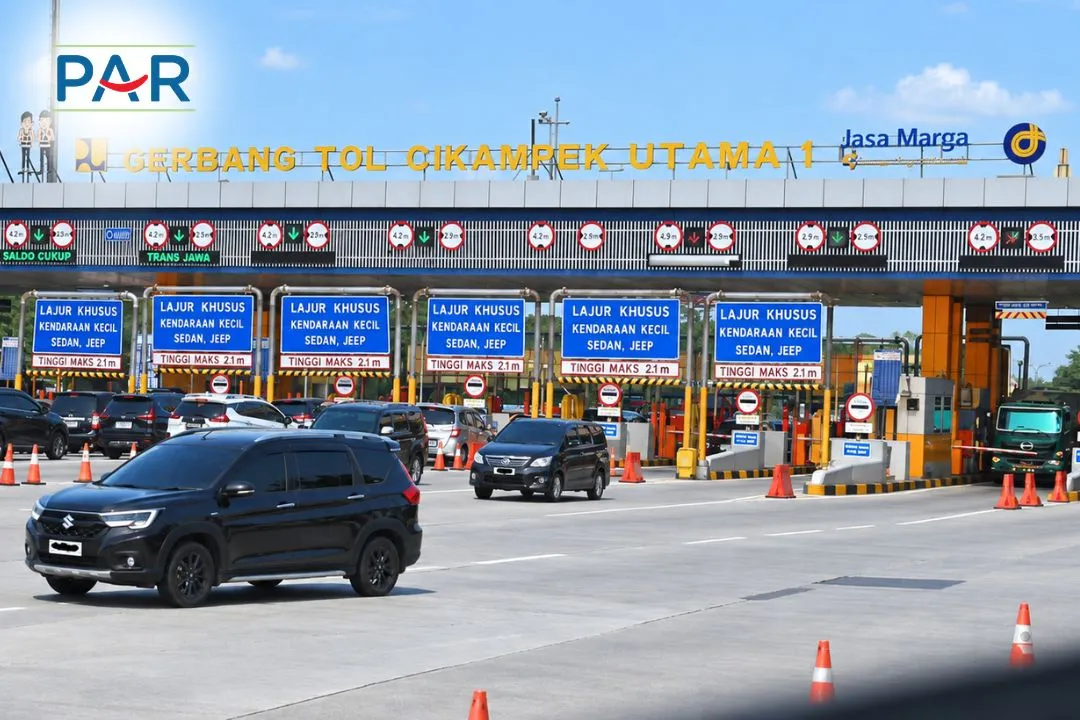
The Jakarta to Surabaya route via the Trans Java Toll Road network stretches around 780 kilometers and passes through 13 toll road sections, with a travel time of around 9 to 11 hours under normal traffic conditions. This route is the main overland corridor for companies making client visits, branch audits, document deliveries, and interprovincial project team deployments.
Inaccurate budgets have a direct impact on operations. A budget that is too small leads to requests for additional funds and slows down the reimbursement process. Conversely, a budget that is too large ties up the company's cash flow for no clear reason. This article provides a complete breakdown, from 2026 Trans Java toll rates by vehicle class and estimated Jakarta to Surabaya fuel costs by vehicle type to personnel costs and a calculation template that finance and General Affairs teams can use right away.
Air travel is certainly faster. However, road travel has several advantages that are relevant for corporate needs.
For these advantages to be truly efficient, every cost component needs to be calculated in detail.
Toll rates in Indonesia are set based on vehicle class. Class I covers sedans, MPVs, SUVs, pick-ups, and buses. Class II is two-axle trucks, Class III three-axle trucks, Class IV four-axle trucks, and Class V trucks with five or more axles. Most passenger company vehicles fall under Class I.
For Class I, data from the Toll Road Regulatory Agency (BPJT) records a total normal rate of Rp935,500 up to the Warugunung Toll Gate. Other figures in circulation range from Rp859,500 for the route entering from the Jakarta to Cikampek Toll Road and exiting at the Warugunung Toll Gate, up to around Rp986,500 based on the breakdown as of March 2026.
Official Jakarta to Surabaya rates for Classes II to V are rarely published in full. We therefore calculated them proportionally from the rate ratio of the Jakarta to Semarang segment, where Classes II and III are Rp639,000 and Classes IV and V are Rp841,000, compared with Rp413,500 for Class I.
Class | Vehicle Type | One-Way Estimate | Round-Trip Estimate |
|---|---|---|---|
I | Sedan, MPV, SUV, pick-up, bus | Rp860,000 to Rp987,000 | Rp1.72 to Rp1.97 million |
II and III | 2 to 3-axle trucks | approx. Rp1.33 to Rp1.52 million* | approx. Rp2.66 to Rp3.05 million* |
IV and V | Trucks with 4 or more axles | approx. Rp1.75 to Rp2.01 million* | approx. Rp3.50 to Rp4.01 million* |
*Proportional estimate. Actual rates may differ.
The differences are generally caused by the toll entry point in Jakarta, the exit gate in Surabaya, and the timing of rate adjustments on each section. Rates can also change during certain periods. For example, during the 2026 Lebaran homecoming season, the government offered a 30 percent discount on the Jakarta to Semarang segment. For budgeting purposes, we recommend using a conservative figure of Rp935,500 one way for Class I.
For the Java region, fuel prices as of September 2026 are as follows: subsidized RON 90 gasoline at Rp10,000 per liter, RON 92 gasoline at Rp15,950 per liter, and non-subsidized diesel at Rp23,700 per liter. The non-subsidized diesel price has risen from Rp19,700 per liter, so diesel vehicles now require a larger share of the fuel budget.
The following simulation uses a one-way distance of 800 km, including city driving in Jakarta and Surabaya.
Vehicle Type | Average Consumption | Fuel Needed | Estimated One-Way Cost |
|---|---|---|---|
1,500 cc gasoline MPV (RON 92) | 12 km/liter | approx. 66.7 liters | approx. Rp1,063,000 |
2,400 cc diesel MPV/SUV | 13 km/liter | approx. 61.5 liters | approx. Rp1,458,000 |
Diesel minibus (10 to 15 seats) | 9 km/liter | approx. 88.9 liters | approx. Rp2,107,000 |
Hybrid MPV (RON 92) | 18 km/liter | approx. 44.4 liters | approx. Rp709,000 |
Actual consumption is affected by load, average speed, AC use, and traffic conditions. Add a 10% reserve to anticipate congestion or detours.
Many private companies refer to the government's Standard Input Costs (SBM) as a benchmark for reasonable spending. Under Minister of Finance Regulation (PMK) No. 32 of 2025, the per diem for out-of-town business trips to East Java is set at Rp410,000 per person per day. For drivers, companies generally set meal and pocket money at around Rp150,000 to Rp250,000 per day, excluding overtime compensation according to internal policy.
Business hotel rates in Surabaya range from Rp500,000 to Rp800,000 per night, while driver accommodation ranges from Rp300,000 to Rp450,000 per night. Make sure driver accommodation is budgeted separately so the driver gets proper rest before the return trip.
Safety is often overlooked in budget planning. Article 90 of Law No. 22 of 2009 states that drivers of public motor vehicles may work no more than 8 hours a day, must rest for at least half an hour after driving for 4 consecutive hours, and in certain cases may be employed for up to 12 hours a day including a 1-hour break. Although these provisions are intended for public vehicles, companies can adopt them as a safety standard for their business fleets.
Since the Jakarta to Surabaya travel time approaches or exceeds these limits, companies have two options: assign two drivers to take turns, or schedule an overnight stop in a transit city. Both options need to be included in the budget from the start.
The table below combines the Class I toll rate (Rp935,500), fuel, and parking and contingency costs of Rp100,000 per trip.
Vehicle Type | One Way | Round Trip |
|---|---|---|
Hybrid MPV | approx. Rp1,744,500 | approx. Rp3,489,000 |
1,500 cc gasoline MPV | approx. Rp2,098,500 | approx. Rp4,197,000 |
Diesel MPV/SUV | approx. Rp2,493,500 | approx. Rp4,987,000 |
Diesel minibus | approx. Rp3,142,500 | approx. Rp6,285,000 |
Scenario: two employees and one driver, using a diesel MPV, for three days and two nights.
Component | Calculation | Cost |
|---|---|---|
Tolls, fuel, parking (round trip) | Table above | Rp4,987,000 |
Employee per diem | 2 people × 3 days × Rp410,000 | Rp2,460,000 |
Driver per diem | 3 days × Rp200,000 | Rp600,000 |
Employee hotel | 2 rooms × 2 nights × Rp650,000 | Rp2,600,000 |
Driver accommodation | 2 nights × Rp350,000 | Rp700,000 |
Mobility in Surabaya | City driving fuel | Rp200,000 |
Total | approx. Rp11,547,000 |
If the company uses its own vehicle, a one-way trip still incurs round-trip costs because the vehicle and driver have to return to Jakarta. This needs to be considered, for example when employees return by plane or train.
The calculation above does not yet include ownership costs. As an illustration, an MPV worth Rp400 million with 12% annual depreciation and 30,000 km of use per year carries a depreciation cost of around Rp1,600 per km. For a 1,600 km trip, depreciation reaches around Rp2.56 million. Add tire wear and routine maintenance, and hidden costs can exceed Rp3 million per trip. On top of that, there is the risk of a breakdown mid-route, insurance costs, annual taxes, and the administrative burden of managing a fleet.
Aspect | Company-Owned Vehicle | Fleet Rental |
|---|---|---|
Upfront investment | Large (unit purchase) | None |
Maintenance and insurance | Borne by the company | Generally included in the contract |
Replacement unit when problems arise | Not available | Generally provided by the provider |
Driver availability | Depends on internal employees | Professional drivers can be included |
Budget certainty | Fluctuating | More measurable under the contract |
For companies with irregular out-of-town travel frequency, fleet rental is often more efficient because costs are variable and technical risks are transferred to the service provider.
Use the following formula as the basis for budgeting:
Total Cost = (Tolls + Fuel + Parking) × Number of Trips + (Per Diem × People × Days) + (Accommodation × Rooms × Nights) + Driver Costs + 10% Reserve
No. | Component | Formula | Value (Rp) |
|---|---|---|---|
1 | Toll fees | Rate per class × number of trips | |
2 | Fuel | (Distance ÷ km/liter consumption) × price per liter | |
3 | Parking and contingencies | Estimate per trip | |
4 | Employee per diem | Number of people × days × daily rate | |
5 | Driver per diem | Number of drivers × days × daily rate | |
6 | Accommodation | Number of rooms × nights × rate | |
7 | Mobility in the destination city | Estimate | |
8 | Reserve | 10% × (total of items 1 to 7) | |
Total budget |
Under normal conditions, the trip takes around 9 to 11 hours, not including mandatory rest breaks for the driver.
According to the latest news reports, the government has guaranteed that subsidized fuel prices will not rise until the end of 2026. Even so, non-subsidized fuel prices can still change every month.
For one person, flying tends to be more efficient. For groups of three or more carrying goods, road travel is generally more economical.
The cost of a Jakarta to Surabaya business trip cannot be calculated from toll fees and fuel alone. For Class I vehicles, toll costs range from Rp860,000 to Rp987,000 one way, while fuel ranges from Rp709,000 to Rp2.1 million depending on the vehicle type. Once per diem, accommodation, and driver costs are added, the total budget for a three-day business trip for three people can reach around Rp11.5 million. Companies also need to account for driver working hour limits and vehicle ownership costs, which are often left out of the calculation.
For companies that want safe, comfortable business trips and a more measurable budget, Prima Armada Raya offers PRIMA Fleet Services for short-term and long-term operational vehicle rental, complete with professional and certified drivers. Backed by more than 3,000 vehicles in operation, real-time fleet monitoring technology, and a network spanning more than 30 operating areas, Prima Armada Raya is ready to support your business mobility along the Trans Java corridor.